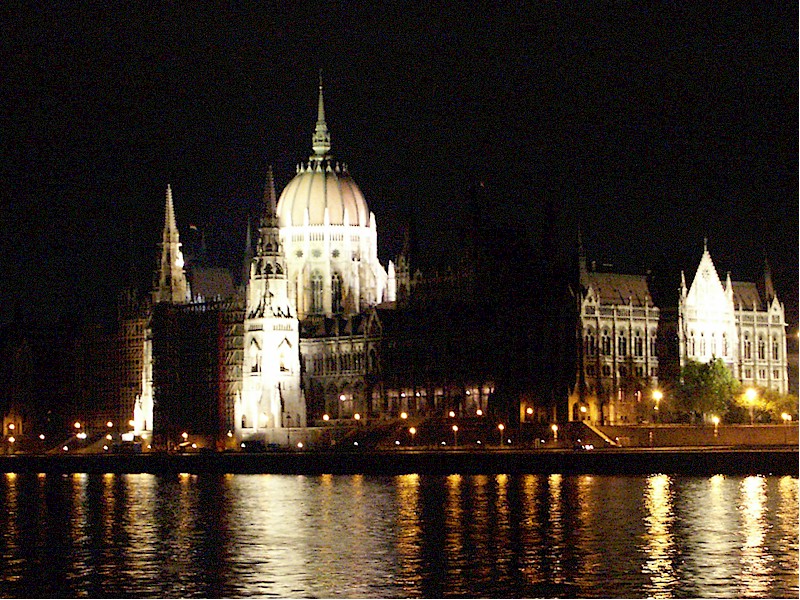
Visiting
the Hungarian Parliament
"The
motherland does not have a house." Thus wrote bitterly Mihály
Vörösmarty,
one of the greatest poets of the Hungarian heroic age of bourgeois
civilization, in 1846. Indeed, through the hundreds of years that the
grandsons
of the conquering chieftain Árpád ruled the country the diet didn't
have a
regular house. But there was no need for it, as they - the prelates,
the
barons, the nobles and the burghers - were "the country". Where they
walked, judged, debated - that was the "motherland". Since the time
of St. Stephen, Hungary's legendary founder, the greatest turn of the
wheel in
Hungarian history occurred in Vörösmarty's generation - the Age of
Reform and
the Revolution of 1848 that followed. Spurred by economic need, social
unrest
and the flowering of culture, the hundredthousands of privileged in
society and
the millions in the lower classes coalesced into a historical
community, the
Hungarian nation. And this nation, now being consciously formed by the
great
men of the age - István Széchenyi, Miklós Wesselényi, Ferenc Deák,
Lajos
Kossuth, Ferenc Kölcsey, Sándor Petőfi -, was very much in need of a
physical
home. As a counterweight to the royal palace rising high on Buda Hill,
the Pest
side of the Danube was chosen to symbolize that Hungary's destiny lay
with
popular democracy and not with royal whim.
The
"House of the Motherland" Is Built
Over the
past thousand years the Hungarian diet has held its sessions from
Sopron to
Szabolcs, from Besztercebánya to Szeged, from Nagyszombat to Rákos
field, and
since the l8th century primarily in Pozsony, today known as Bratislava.
In July
1843, the reform opposition tabled an ol d proposal that the
legislature should
be moved to the new capital, Pest-Buda. In September a parliamentary
commission
took the matter in hand, and after several fruitful discussions, the
future
Minister himself, Gábor Klauzál, declared that "because there is a
place,
the dream will become a reality". But in the ensuing decades only
design
competitions were realized where often not even prizes were awarded. By
the
time, forty years later, a law concerning the construction of a
parliament was
finally passed, the concept of parliament had changed dramatically. Not
only
was a completely different physical home envisioned but the notion of
popular
representation and the government responsible to it had a completely
different
sound as well by the end of the century. The competition announced in
1882 was
won by Imre Steindl (1839-1902), a professor at the Technical
University.
d proposal that the
legislature should
be moved to the new capital, Pest-Buda. In September a parliamentary
commission
took the matter in hand, and after several fruitful discussions, the
future
Minister himself, Gábor Klauzál, declared that "because there is a
place,
the dream will become a reality". But in the ensuing decades only
design
competitions were realized where often not even prizes were awarded. By
the
time, forty years later, a law concerning the construction of a
parliament was
finally passed, the concept of parliament had changed dramatically. Not
only
was a completely different physical home envisioned but the notion of
popular
representation and the government responsible to it had a completely
different
sound as well by the end of the century. The competition announced in
1882 was
won by Imre Steindl (1839-1902), a professor at the Technical
University.
Like
others of his generation he thought that problems in construction could
be most
easily solved by combining old style elements with modern technique in
a
relatively free manner. This combination of old with new had been
spreading
through the arts since the Renaissance, first manifesting itself in
neoclassicism which drew upon the ancient greek and roman styles, and
later in
romanticism which referred to the architectural design of the middle-
and early
modern-ages. Some artists strove for completely faithful
reconstruction, by
building in a "pure" neoroman, neorenaissance or neobaroque style.
Other artists tried to mix the basic forms of the great periods, but
the
developing eclecticism - with a few important exceptions - came to an
impasse.
This sampling of historical architectural forms in time compromised the
integrity of the building, rendering it incapable of faithfully
representing
human values or expressing a lasting message. The unanimous opinion of
art
historians and thousands of visitors alike is that the Parliament
designed by
Imre Steindl is one of the happy exceptions of historical eclecticism.
The style
of the exterior recalls Gothic
Revival, which developed in England in the
1830's. A foremost example of this style is Ch. Barry's and A.W.
Pugin's
masterpiece, the Parliament in London. Steindl too was unafraid to
introduce
new elements where the functionality of the building required. For
instance, he
introduced a form almost unknown in gothic, the dome, and placed it at
the core
of his monumental work. Similarly, when organizing the internal spaces
he
utilized principles borrowed from
renaissance and baroque - the greatest
example being the main staircase which leads to the dome. "I didn't
want
to create a new architectural style for the Parliament," he confessed
upon
accepting his academic chair, "because I couldn't balance a building
that
has to stand for hundreds of years with ephemeral details. I have tried
modestly and carefully, as is required by art, to bring a national and
unique
spirit to this magnificent medieval style." On 12 October 1885 ground
was
broken on the quay at Tömő square in the Lipót district. With an
average of
1000 workers laboring at any one time, the building took 17 years to
complete.
It was the greatest investment of the time. Because the builders strove
to use
- whenever possible - Hungarian materials, Hungarian techniques, and
Hungarian
master craftsmen, entire industries flourished. The total cost
ballooned from
18.5 million to 38 million gold crowns. Around 176,000 cubicmeters of
earth was
moved and 40 million bricks were used. In addition, more than half a
million
ornamental stones were carved for the wall decorations. (Unfortunately,
the
soft limestone employed quickly began to corrode and is now being
constantly
replaced by harder stone.) The building is 268 m long, 123 m wide
across the
center, has a dome 96 m high and covers 18,000 square meters of surface
area
and 473,000 cubic meters of space. The building stands on a 2-5 m thick
gigantic concrete foundation. 90 statues and the coats-of-arms of
various
cities and counties adorn the exterior while on the inner walls can be
found
152 statues and motives of national fauna. Nearly 40 kg of 22-23 karat
gold was
used for decorations.
The
building has 27 gates, 29 interior staircases and 13 personal and
service
elevators. Around 50 five story apartment buildings could fit into the
Parliament which gives the vistor a notion of its size. Aesthetically
the main
facade faces the Danube, but the o ffical main entrances
lies on Kossuth square.
The building with its symmetrical structure conforms to the functions
of a
bicameral parliament. Just like the Capitol Building in Washington,
D.C., the
northern and southern wings of the building each serves one house of
the
legislature. They are connected by an enormous dome hall, which was
once the
site of unified sessions. Since the end of World War II the building
has also
been the host of the executive branch. The northern wing houses the
offices of
the Prime Minister, while the southern wing contains those of the
Pesident of
the Republic. And in the corner rooms of the northern wing the Speaker
of the
Parliament has his offices.
ffical main entrances
lies on Kossuth square.
The building with its symmetrical structure conforms to the functions
of a
bicameral parliament. Just like the Capitol Building in Washington,
D.C., the
northern and southern wings of the building each serves one house of
the
legislature. They are connected by an enormous dome hall, which was
once the
site of unified sessions. Since the end of World War II the building
has also
been the host of the executive branch. The northern wing houses the
offices of
the Prime Minister, while the southern wing contains those of the
Pesident of
the Republic. And in the corner rooms of the northern wing the Speaker
of the
Parliament has his offices.
The Main
Staircase
On either
side of the exterior stairs tourists are welcome by the lion statues of
Béla
Markup. Though the originals were destroyed in the war, they were
reformed by
József Somogyi. Those touring Parliament, however, enter though gate
number XII
on the corridor parallel with the main facade, and proceed to the main
interior
staircase, where they begin their tour of Parliament.
The main
staircase  sweeping from the main
entrance to the Dome Hall is one of the most
brilliant architectural creations of Steindl. Extremely imposing are
the
dimensions of the main staircase occupying
nearly the entire width of the
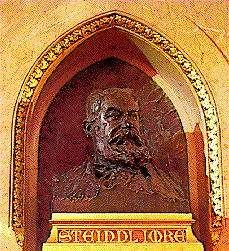
interior room from the landing to the dome. Deservedly a bronze bust of
the
architect, cast by Alajos Stróbl, was set into the left marble wall in
1904.
Imre Steindl inherited a love of handicraft from his jeweler father.
When he
was a student of Friedrich Schmidt - the outstanding master of
neogothic - in
Vienna, he didn't forget his years of apprenticeship as a mason. Even
as a
professor at the university he was not ashamed to take trowel in hand
to
introduce his students to the mysteries of art restoration. Of the
columns
supporting the ceiling of the main stair hall 8 stand out. The deep red
granite
columns are 6 m in height and weight 4 tons each. They originate from
Sweden
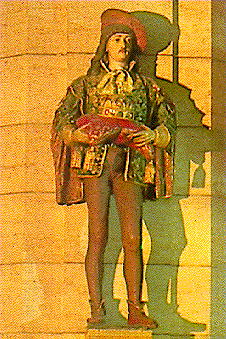
and all 8 were cut from the same cliff face. Statues of pages, holding
the
coronation symbols, look down upon the stairs. They are made from
cast-zinc
and, in a somewhat forced fashion, are reminiscent of the mannerisms of
painted
gothic wooden figures. On the ceiling three allegorical frescoes by
Károly Lotz
enable the visitor to understand the concepts embodied by the hall.
closest to
the entrance "The Apotheoses of the Legislation" can be seen. It
depicts a thousand years of the rule of law in Hungary. On the column
rising
middle of the picture Hungary's most famous laws can be read. (It is
perhaps no
accident that these laws begin with the Austrian- Hungarian Compromise
of
1867.) The ancient looking plinth is decorated by a relief showing the
blood
compact of the seven ancient tribal chiefs. In the hands of the figures
appear
the Hungarian crown and the coat-of-arms.
sweeping from the main
entrance to the Dome Hall is one of the most
brilliant architectural creations of Steindl. Extremely imposing are
the
dimensions of the main staircase occupying
nearly the entire width of the
interior room from the landing to the dome. Deservedly a bronze bust of
the
architect, cast by Alajos Stróbl, was set into the left marble wall in
1904.
Imre Steindl inherited a love of handicraft from his jeweler father.
When he
was a student of Friedrich Schmidt - the outstanding master of
neogothic - in
Vienna, he didn't forget his years of apprenticeship as a mason. Even
as a
professor at the university he was not ashamed to take trowel in hand
to
introduce his students to the mysteries of art restoration. Of the
columns
supporting the ceiling of the main stair hall 8 stand out. The deep red
granite
columns are 6 m in height and weight 4 tons each. They originate from
Sweden
and all 8 were cut from the same cliff face. Statues of pages, holding
the
coronation symbols, look down upon the stairs. They are made from
cast-zinc
and, in a somewhat forced fashion, are reminiscent of the mannerisms of
painted
gothic wooden figures. On the ceiling three allegorical frescoes by
Károly Lotz
enable the visitor to understand the concepts embodied by the hall.
closest to
the entrance "The Apotheoses of the Legislation" can be seen. It
depicts a thousand years of the rule of law in Hungary. On the column
rising
middle of the picture Hungary's most famous laws can be read. (It is
perhaps no
accident that these laws begin with the Austrian- Hungarian Compromise
of
1867.) The ancient looking plinth is decorated by a relief showing the
blood
compact of the seven ancient tribal chiefs. In the hands of the figures
appear
the Hungarian crown and the coat-of-arms.
The
subject of the second painting is the "Glorification of Hungary" also
containing unambiguous historical references. At the feet of the woman
holding
the coat-of-arms is István Széchenyi on the left and Petőfi Sándor on
the
right. Petőfi, posed as he is in the memorable statue by Adolf Huszár,
is
leading an enthusiastic crowd who are dressed is Hungarian clothing and
waving
Hungarian flags. The third picture shows the Hungarian "middle
coat-of-arms" - the unified heraldic symbol of Dalmatia, Croatia,
Slavonia, Transylvania, Fiume and Hungary - supported by angels.
The Dome
Hall
Reaching
the top of the stairs, the visitor enters the Dome Hall whose 16
corners
amplify the sensation of space. It is true that the inside ceiling is
much
lower than the outside cupola, but this ingenious structure gives the
feeling
that this 27 m high round room is imposingly high. This splendid hall
is the
structural and spiritual heart of the building, and on occasion hosted
the
combined sessions of both houses of Parliament. Together with the main
entrance, this was one of the first parts of the building to be
finished, so
that in 1896 Parliament could hold its festival session for the
millenium
celebrations. The statues and coats-of-arms of 16 rulers which are
placed
around the interior of the Dome Hall provide the admiring visitor with
a brief
history lesson. Opposite the main stairs the series starts with the
chieftain
Árpád and proceeds clockwise with St. Stephen, St. Ladislaus, Könyves
Kálmán,
András II, Béla IV, Louis the Great, János Hunyadi and Mátyás Hunyadi.
Then
follows the Transylvanian princes, István Báthory, lstván Bocskai,
Gábor
Bethlen. The final three figures are Habsburg rulers, Charles IIl,
Maria
Theresa and Leopold II. These royal statues, as well as their companion
pieces
in the longues, halls and corridors, are works of the most famous
Hungarian
sculptures of the day. Besides the already mentioned cast-zinc,
pyrogranite was
used - the latest curiosity from the Vilmos Zsolnay ceramics factory in
Pécs.
Pyrogranite proved to be ideal for covering exterior walls and it is on
these
that many of the stylized depictions of the national flora appear. But
as a
basic material for statues - as critics have noted for the last 90
years - it
wasn't the most fortunate choice. "Misshapen figures with parrot
colors,
misnamed statues," grunted Zoltán Pap, a deputy in 1902 who complained
that the vivid colors only emphasized the conventionality of
their form.
Besides the material, a bigger problem was the boring monotonity of the
modeling. Although the criticism is not unfounded, the statues have
been from
the very beginning special, indispensable components of the atmosphere
of
"The House of the Motherland". Marble tablets at the sides of the
columns in the Dome Hall represent the national memory. These four
marble
tablets commemorate the building of Parliament, the celebration of the
millenium of the conquest, details from St. Stephen's exhortations and
perhaps
as a sort of compensation since as the leader of the most powerful
anti-Habsburg rebellion his place should have been among the rulers - a
dedication to the glorious memory of Ferenc Rákóczi II.
Rooms
Around the Dome Hall
Fascinating
rooms surround the Dome Hall from the Danube side. Opposite the main
staircase
is Hunter Nall, the great dining hall of Pa rliament, decorated on
the riverside
by a colonnaded terrace. The fresco on the southern wall, the portrayal
of the
two Hun brotherkings, Buda and Attila, engaged in the princely
pastime of bison
hunting. A work by Aladár Kőrösfői-Kreisch, commemorates János Arany's
beautiful verse: "The cry of the hunt sounds in the valley Nowhere on
land, nowhere in the sky Does a wild beast remain." Someone wishing to
enjoy a more peaceful sight need merely to turn to the northern
side of the
room where a fresco showing a fishing party on Lake Balaton can be
admired.
This work, an outstanding representative of the Hungarian secessionist
style,
depicts Tihany Peninsula with the Benedictine Abbey. In the foreground
the
monks directing the fishing net represent a thousand year old tradition
of
Hungarian history - the silent workers underpinning civilization's
achievements. On the ceiling Viktor Tardos-Kenner painted
the allegorical
figures of Reaping, Harves and Abundance. On the entrance wall Béla
Spányi
painted five famous Hungarian
castles. The first is in the center of the
Hunyadi ancestral estate - Vajdahunyad Castle; the next is Árva Castle,
recalling Thurzo and Thököly; in the middle is the Anjou and Hunyadi
castle at
Visegrád (this is the only castle which is within the borders of modern
Hungary); then comes Klissa, a famous Dalmatian fort of an order of
German
knights; and finally, Máté Csák's citadel at Trencsén. From the corners
of Hunter
Hall two smaller rooms open out. The southern room plays host to the
deputies'
cafeteria and the northern - the Tapestry Room - houses press
conferences. It
was in the 1920's that the 9 X 3 meter tapestry which gives the room
its name
was hung here. The tapestry, designed by Gyula Rudnay and completed in
two
years by thirty weavers was inspired by the lines of Anonymus, a
chronicler at
the court of King Béla. "The leader and his nobles have made all the
rules
and laws of the country," he wrote. "The place where all of these
were done was named by the Hungarians in their own tounge - Szeri,
because
there they proclaimed all the things of the country." Even though it is
more than likely that the conquerors never actually held a session at
Pusztaszer, the ingenious explanation given by Anonymus for the name of
this
locality is a perfect symbol for the birth of Hungarian
constitutionalism.
rliament, decorated on
the riverside
by a colonnaded terrace. The fresco on the southern wall, the portrayal
of the
two Hun brotherkings, Buda and Attila, engaged in the princely
pastime of bison
hunting. A work by Aladár Kőrösfői-Kreisch, commemorates János Arany's
beautiful verse: "The cry of the hunt sounds in the valley Nowhere on
land, nowhere in the sky Does a wild beast remain." Someone wishing to
enjoy a more peaceful sight need merely to turn to the northern
side of the
room where a fresco showing a fishing party on Lake Balaton can be
admired.
This work, an outstanding representative of the Hungarian secessionist
style,
depicts Tihany Peninsula with the Benedictine Abbey. In the foreground
the
monks directing the fishing net represent a thousand year old tradition
of
Hungarian history - the silent workers underpinning civilization's
achievements. On the ceiling Viktor Tardos-Kenner painted
the allegorical
figures of Reaping, Harves and Abundance. On the entrance wall Béla
Spányi
painted five famous Hungarian
castles. The first is in the center of the
Hunyadi ancestral estate - Vajdahunyad Castle; the next is Árva Castle,
recalling Thurzo and Thököly; in the middle is the Anjou and Hunyadi
castle at
Visegrád (this is the only castle which is within the borders of modern
Hungary); then comes Klissa, a famous Dalmatian fort of an order of
German
knights; and finally, Máté Csák's citadel at Trencsén. From the corners
of Hunter
Hall two smaller rooms open out. The southern room plays host to the
deputies'
cafeteria and the northern - the Tapestry Room - houses press
conferences. It
was in the 1920's that the 9 X 3 meter tapestry which gives the room
its name
was hung here. The tapestry, designed by Gyula Rudnay and completed in
two
years by thirty weavers was inspired by the lines of Anonymus, a
chronicler at
the court of King Béla. "The leader and his nobles have made all the
rules
and laws of the country," he wrote. "The place where all of these
were done was named by the Hungarians in their own tounge - Szeri,
because
there they proclaimed all the things of the country." Even though it is
more than likely that the conquerors never actually held a session at
Pusztaszer, the ingenious explanation given by Anonymus for the name of
this
locality is a perfect symbol for the birth of Hungarian
constitutionalism.
The
Deputy Council Chamber and the Lounge the Deputies
As the
visitor arrives from the main stairs and stops in the middle of the
Dome Hall,
under the rose candelabra, she will have a magnificent view of the
functional
structure of the building. The view through the open doors at the end
of both
sides opens directly on to the Speaker's lectern in each of the two session
rooms.
Since December 1944 the Hungarian legislature has been monocameral. As
there is
only legislative body, the former session room of the Upper House is
now used
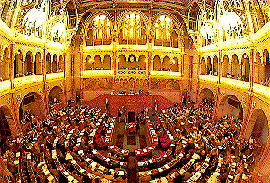
for holding international conferences. Turning first to the southern
side, the
visitor comes upon the Deputy Council Chamber, where the Hungarian
legislature
sits today. On the way to the chamber the visitor must first cross the
lounge .
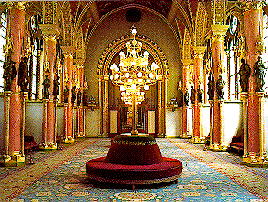
This
room, instead of being the site for a fruitful exchange of views
between the
deputies (these are held today mostly in the
corridors), is used by the press.
The statues are allegorical symbols of the technical sciences and a few
important branches of industry and commerce. Historians consider it a
symptom
of the cultural politics of this period that, in the execution of the
paintings
in the Parliament, a disproportionately large role was accorded to
Zsigmond
Vajda, who was a painter of more modest talents. In this room some of
his
rather crowded compositions depict images from the Hun-Magyar legendary
world -
the Mythical Stag, Attila's Sword, Buda's Death and Emese's Dream. At
the end
of the lounge, on the other side of a short corridor, is the Deputy
Council
Chamber .
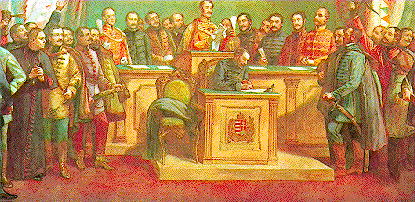
Through
the ogive arch of windows a gentle light
shines evenly over the entire space of
the most important room in the building. (The room is 25 m deep, 23 m
in length
and 17 m high at its extremes.)
The warm brown of the Slavonian oak, a
deservedly famous building and decoration material, gives the room its
color.
Inside the acoustically superb
council chamber are 438 specially designed
leather chairs for the deputies, while the velvet-upholstered seats in
the
inner circle are reserved for the ministers of the government. The
middle area
opening off of the Speaker's lectern is slightly recessed to
accommodate a
table for the shorthand writers. Formerly, the junior-clerk of the
Parliament
placed here the summary of a thousand years of legislative activity -
the
volumes of the Corpus Juris. The Speaker and the clerks sit on a platform which
is raised for acoustical reasons. In the middle carving of the
Speaker's
lectern is a
bullethole, made when a pistol was fired at the Speaker, István
Tisza, who had been grossly violating the internal rules of the
Parliament. On
4 June 1912 a would-be assassin attempted to prevent Tisza from
pursuing
illegal and violent measures aimed at bringing an end to the
opposition's
filibustering which was paralyzing the work of thf The House.
opposition felt
that they
needn't keep to the rules of parliamentary etiquette in the presence
of a majority which had won the elections by manipulation. After his
failed
attempt the assailant turned the gun against himself, and the unharmed
Speaker
continued the session. There were other equally dramatic moments in the
Parliament
from the
breaking of furniture to the removal of deputies by the police. This
is why "stormbells" were placed behind the Speaker's lectern on both
sides. But it is not these horrible shrill bells which keep the peace
but
rather the lofty statues representing Harmony, Peace and Wisdom which
calm the
souls of the statesmen. But if truth be told, standing between these
gilded
figures are those of Glory, Eloquence and War. Above the Speaker's
lectern is
placed the middle coat-of-arms, while on either side of the actual
lectern are
tempera paintings by Zsigmond Vajda. The one on the left shows the
symbolic
birth of the Austro-Hungarian Dual Monarchy - the crowning as Hungarian
king of
Franz Joseph, the man who sent the martyrs of Arad to the gallows after
putting
down the Revolution of 1848. The other picture is much more important
however.
Here, too, there is a Habsburg - a cousin of Franz Joseph - but in a
completely
different role.
platform which
is raised for acoustical reasons. In the middle carving of the
Speaker's
lectern is a
bullethole, made when a pistol was fired at the Speaker, István
Tisza, who had been grossly violating the internal rules of the
Parliament. On
4 June 1912 a would-be assassin attempted to prevent Tisza from
pursuing
illegal and violent measures aimed at bringing an end to the
opposition's
filibustering which was paralyzing the work of thf The House.
opposition felt
that they
needn't keep to the rules of parliamentary etiquette in the presence
of a majority which had won the elections by manipulation. After his
failed
attempt the assailant turned the gun against himself, and the unharmed
Speaker
continued the session. There were other equally dramatic moments in the
Parliament
from the
breaking of furniture to the removal of deputies by the police. This
is why "stormbells" were placed behind the Speaker's lectern on both
sides. But it is not these horrible shrill bells which keep the peace
but
rather the lofty statues representing Harmony, Peace and Wisdom which
calm the
souls of the statesmen. But if truth be told, standing between these
gilded
figures are those of Glory, Eloquence and War. Above the Speaker's
lectern is
placed the middle coat-of-arms, while on either side of the actual
lectern are
tempera paintings by Zsigmond Vajda. The one on the left shows the
symbolic
birth of the Austro-Hungarian Dual Monarchy - the crowning as Hungarian
king of
Franz Joseph, the man who sent the martyrs of Arad to the gallows after
putting
down the Revolution of 1848. The other picture is much more important
however.
Here, too, there is a Habsburg - a cousin of Franz Joseph - but in a
completely
different role.
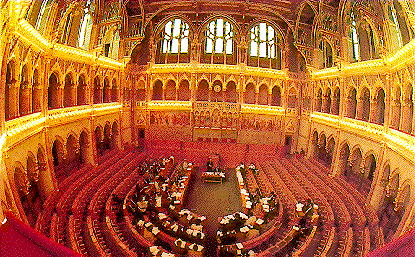
The
picture portrays a significant
moment in Hungarian parliamentary history:
Palatine István on 5 July 1848 opening the first session of the first
Hungarian
popular representative assembly. Of course, tendentious legend and
romantic
pipe-dreams maintain that the origins of the institution of parliament
date
back a thousand years to when the Magyar tribes
first conquered the Carpathian
basin. Current research has been able to determine with a high degree
of
certainty what kind of institutions of his own time Anonymus, who was
attempting to descrive events that occurred nearly 200 years before,
introduced
into his depiction of the blood compact as well as into his explanation
for the
place name, Pusztaszer (recall the Tapesty Room). In the history of the
Middle
Ages numerous different types of national assemblies or gatherings can
be found
all over Europe. Of these the most important in Hungary as well - was
the royal
council governing the early feudal state. The make-up of these powerful
judicial and governmental assembly sessions was gradually broadened to
include
not just the prelates and barons but in some way or another
representatives of
other groups in society. Often it was a war council that provided the
occasion
for an assembly, at other times a church council. For example, at the
famous
Council of Szabolcs hosted by King Saint Ladislaus 1 in 1092, decisions
were
made with the cooperation of secular figures, prelates and
representatives of
the people.
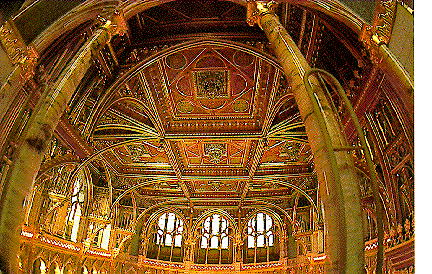
A true
national assembly can only be born of such gatherings if the concept of
country
or state already exists. In other words, the state
must be more that just the
king's person; it must encompass as well a community which is made up
of
smaller groupings possessing political rights. A thorough examination
of
documents from the Middle Ages shows that these groupings - the estates
-
formulated the body of their rights and interest under the influence of
rediscovered Roman law and with the help of shifting canon law. Solid
research
of the last several years indicates that besides Hispania,
England, some areas
of Scandinavia, and a small Italian princedom, the Friaul-Aquileia
patriarchate, Hungary developed the earliest - in the decades between
1270 and
1300 - institutions based on the estates. In 1277 on Rákos field,
members of
the country held an assembly at which prelates, barons, nobles and the
kuns all
participated. The nobles - most of whom had been subservient to the
King,
gaining rights only with the proclamation of the Golden Bull in 1222 -
were, of
course, far from being staunch supporters of the throne in the power
struggle
against the provincial lords. In any case, laws enacted by the national
assemblies of 1290 and 1298 show clearly that the group of Hungarian
prelates
and church intellectuals organizing the institutions of the early
estate system
not only stood at the leading edge of European legal and political
culture but
were also attempting, in full awareness of their responsibility, to
direct the
fate of a country foundering in anarchy in the final days of the Árpád
dynasty.
During the time of the Anjous the memory of these early estate
institutions
faded. The sporadically held assemblies of this period did not
themselves write
laws but merely passed those drawn up by the king. It was not until the
first
half of the l5th century, towards the end of Zsigmond's reign and
during the
time of Ulászló I and primarily during the governance of János Hunyadi,
that
feudal monarchy stabilized. At its center in Hungary was the
institutional
system of feudal assemblies, aiding the king while at the same time
constrained
by law. At this time a new grouping, the burghers - fourth in
importance -
gained the right to have their representatives participate in
legislation, the
enactment of taxes, declarations of war and peace negotiations,
occasionally
the election of the palatine and other high-ranking officials, judicial
processes, and other national assembly work. Finally in 1608 a law was
passed
to c onfirm
the century-old common law, according to which the prelates and the
barons sat personally in the upper chamber, while chosen delegates of
the
counties, the free royal cities, the free territories and the chapters
conducted the business of the country in the lower chamber. From the
end of the
l8th century the intellectual program of the Enlightenment, the
philosophical
and political formulation of man's right to personal autonomy, made new
demands
on Hungarian legislation. If every man is equal at birth then not just
the
privileged but all men are full members of the "country". The serfs
and the millions in the lower classes must at once "be included into
the
sanctity of the Constitution" ; they, too, must win representation in
the
national assembly. This became one of the most important demands of the
reformers in the bourgeois transformation of Hungarian society, which
was
triggered by the economic and social crises of the time. This objective
of the
program for the bourgeois transformation of the state structure - that
is, the
creation of popular representation in the county and national
assemblies - was
organically complemented by the other fundament of a true parliament,
the rapid
introduction of responsible government. Many important details of this
dual
problem were formulated in the 1790's by József Hajnóczy, one of
Hungary's most
important bourgeois thinkers. In the early 1830's in the fight for
larger steps
towards the gradual introduction of true representation and responsible
government, Miklós Wesselényi and Ferenc Kölcsey, as well as the young
Lajos
Kossuth who later played a huge role in the creation of a modern
bourgeois public,
elevated to a political program the reconciliation of the interests of
the
nobles and the serfs. It was Kossuth who was the most vehement
representative
within the liberal reform opposition headed by Ferenc Deák and Lajos
Batthyány
in the 1840's of the view that, despite the position and influence of
the
privileged estates in the court at Vienna, only through broadening the
reform
of popular representation could the national assembly bring to a
victorious
conclusion its "homeland and progress" campaign. Though it was the
Revolution in the Spring of 1848 that fnally made it possible, it was
really as
a result of the passionate battles of the preceding decades that Acts
on
popular representation and responsible government were finally adopted.
And it
is on this legal basis that today's national assembly functions as
well.
Zsigmond Vajda's painting then - returning to the Deputy Council
Chamber -
depicts the opening of the first parliament which represents free
citizens
(even if their number was restricted by assets and educational
preconditions)
instead of the privileged estates. For the first time in Hungarian
history
executive power had rights delimited by constitutional responsibility.
The
painting was styled on a lithograph by József Borsos and August
Pettenkofen. To
the side of the Palatine and the central group from the Batthyány
Government
are famous liberal politicians authentically portrayed.
onfirm
the century-old common law, according to which the prelates and the
barons sat personally in the upper chamber, while chosen delegates of
the
counties, the free royal cities, the free territories and the chapters
conducted the business of the country in the lower chamber. From the
end of the
l8th century the intellectual program of the Enlightenment, the
philosophical
and political formulation of man's right to personal autonomy, made new
demands
on Hungarian legislation. If every man is equal at birth then not just
the
privileged but all men are full members of the "country". The serfs
and the millions in the lower classes must at once "be included into
the
sanctity of the Constitution" ; they, too, must win representation in
the
national assembly. This became one of the most important demands of the
reformers in the bourgeois transformation of Hungarian society, which
was
triggered by the economic and social crises of the time. This objective
of the
program for the bourgeois transformation of the state structure - that
is, the
creation of popular representation in the county and national
assemblies - was
organically complemented by the other fundament of a true parliament,
the rapid
introduction of responsible government. Many important details of this
dual
problem were formulated in the 1790's by József Hajnóczy, one of
Hungary's most
important bourgeois thinkers. In the early 1830's in the fight for
larger steps
towards the gradual introduction of true representation and responsible
government, Miklós Wesselényi and Ferenc Kölcsey, as well as the young
Lajos
Kossuth who later played a huge role in the creation of a modern
bourgeois public,
elevated to a political program the reconciliation of the interests of
the
nobles and the serfs. It was Kossuth who was the most vehement
representative
within the liberal reform opposition headed by Ferenc Deák and Lajos
Batthyány
in the 1840's of the view that, despite the position and influence of
the
privileged estates in the court at Vienna, only through broadening the
reform
of popular representation could the national assembly bring to a
victorious
conclusion its "homeland and progress" campaign. Though it was the
Revolution in the Spring of 1848 that fnally made it possible, it was
really as
a result of the passionate battles of the preceding decades that Acts
on
popular representation and responsible government were finally adopted.
And it
is on this legal basis that today's national assembly functions as
well.
Zsigmond Vajda's painting then - returning to the Deputy Council
Chamber -
depicts the opening of the first parliament which represents free
citizens
(even if their number was restricted by assets and educational
preconditions)
instead of the privileged estates. For the first time in Hungarian
history
executive power had rights delimited by constitutional responsibility.
The
painting was styled on a lithograph by József Borsos and August
Pettenkofen. To
the side of the Palatine and the central group from the Batthyány
Government
are famous liberal politicians authentically portrayed.
The Old
Upper House Hall and the Lounge
 Opposite
the Deputy Council Chamber, to the right of the Dome Hall in the
northern wing
is the successor to the chamber of the privileged estates, the Clpper
House.
The walls and the carpet of the longue are colored blue. The statues
are
allegorical depictions of agricultural and industrial branches.
Opposite
the Deputy Council Chamber, to the right of the Dome Hall in the
northern wing
is the successor to the chamber of the privileged estates, the Clpper
House.
The walls and the carpet of the longue are colored blue. The statues
are
allegorical depictions of agricultural and industrial branches.
The
paintings on the ceiling , also works of Zsigmond Vajda, have
historical
subjects: St. Ladislaus finding medicinal herbs; Könyves Kálmán
prohibiting the
burning of witches; St. Stephen welcoming the monk Astrik who is
bringing him
the crown; the apotheoses of the Holy Cross; King Mátyás dispensing
justice;
and Louis the Great ordering the building of the church at Kassa. In a
curious
addition to this last painting the artist included a portrait of not
just
himself but of the dome's restorer, lmre Steindl.
Due to
the symmetry of the building the Upper House Hall is just as imposing
as the
Deputy Council Chamber. After the war it was restored but not to its
original
state. They did preserve, however, the brown-gold shine of the interior
and the
original gilded cast statues: Science, Power, Truth, Criticism, Faith
and
Charity. The paintings of Mátyás Jantyik, while new, retain the
political
content of the originals. Just as in the Deputy Council Chamber the
theme of
the independent Hungarian heritage dominates. Here it manifests itself
in a
composition about the proclamation of the Golden Bull, while loyalty to
the
Habsburgs is represented by a depiction of the oath to the young Maria
Theresia, offering military protection for her throne.
The
Delegation Room and Corridor
Exiting
the council rooms a visitor may take a variety of paths to reach a part
of the
main staircase - near the entrance - not yet discussed. Along the way
can be
seen the beautiful window compositions of Miksa Róth, one of the
premier glass
painters of the fin-de-siécle.
A glance
should be reserved for the decorated gratings of the heating system,
which
maintains a constant temperature in the building. Technical knowledge
is
married to practical ingenuity in the corridors where numbered ashtrays
allow
the deputies to dash into the council chamber to vote without having to
stub
out their scented Havannas. The corridor of the Delegation Room is
decorated
with the paintings of Andor Dudits, symbolizing the main ministries:
Defence,
Religion and Culture, Justice, Agriculture, Industry, and Commerce.
Formerly
the offices of the ministers opened off this corridor (e.g. the office
of the
Speaker of the Parliament was once the office of the Minister of
Religion and
Culture). This large room above the main entrance got its name during
the Dual
Monarchy when 120 individuals, delegations
of 60 persons each from each
Parliament, exercised supervision over the common ministries (Defence,
Foreign
Affairs and Finance). During the sessions
held in Pest the Austrian partners
admired the central work of Master Dudits' youth, the painting covering
the
western wall. The moment of the sword stroke at the coronation of Franz
Joseph
in 1867 is today more a symbol of the illusions of the past than of the
achievements of that "social order". The most remarkable feature of
the former room of the Council of Ministries, which opens from the
southern end
of the corridor, is the ceiling paintings of Károly Lotz, "Fortitude"
and "Wisdom" - his most outstanding works in the Parliament.
The
President of the Republic's Receptions Rooms
Today the
two extreme wings of the Parliament house the offices of the country's
most
important public personages. The northern wing is for the Prime
Minister, while
the southern is reserved for the President of the Republic. Two
noteworthy
rooms open from the President's offices. In one of them is the
"Apotheoses
of Hungarian Rulers", a group of paintings done between the two world
wars
by Géza Udvary and Antal Diósy. On the longer wall, Udvary represented
the victorious János Hunyadi listening to the noontime bells, tolling
according to
the Pope's decree in honor of Hunyadi's victory against the Turks near
Nándorfehérvár, today called Belgrade - hence the title of the room,
the
Nándorfehérvár Hall. On the northern wall Udvary painted the apotheoses
of
Lajos Kossuth with Petőfi, Bem and Damjanich, all heroes of the 1848
Revolution.
victorious János Hunyadi listening to the noontime bells, tolling
according to
the Pope's decree in honor of Hunyadi's victory against the Turks near
Nándorfehérvár, today called Belgrade - hence the title of the room,
the
Nándorfehérvár Hall. On the northern wall Udvary painted the apotheoses
of
Lajos Kossuth with Petőfi, Bem and Damjanich, all heroes of the 1848
Revolution.
The
Munkácsy Room, opening from the President's office, houses the most
precious
work of art in the Parliament. "The Conquest" , which Munkácsy, who
was living in Paris at the time, originally intended for the Deputy
Council
Chamber, ended up in this room because among other things the Speaker's
lectern
had to be raised for acoustical reasons. More importantly many deputis
protested that Mihály Munkácsy represented the first meeting between
the
conquerors and the original inhabitants of the region as a peaceful
greeting
and not as a victorious submission. It took twenty years after the
completion
of the work for it to placed here.
The
Parliament Library
There is
not a parliament in the world which does not have a libray of its own.
A sound
decision requires a wealth of information, a purpose served by the
Parliament
Library. This first-rate institution serves more than just the
deputies. It
functions as a national library as well, specializing in law, recent
history,
U.N. publications and, of course, in parliamentarianism. The
Information and
Documentation Centre of the Council of Europe is situated here as well.
(The
documents of the Parliament are adminsitered by Archives.) Access to
the half
million volumes is facilitated by numerous informational systems. The
massive
reading room is situated under Hunter Hall.